Imagining the future
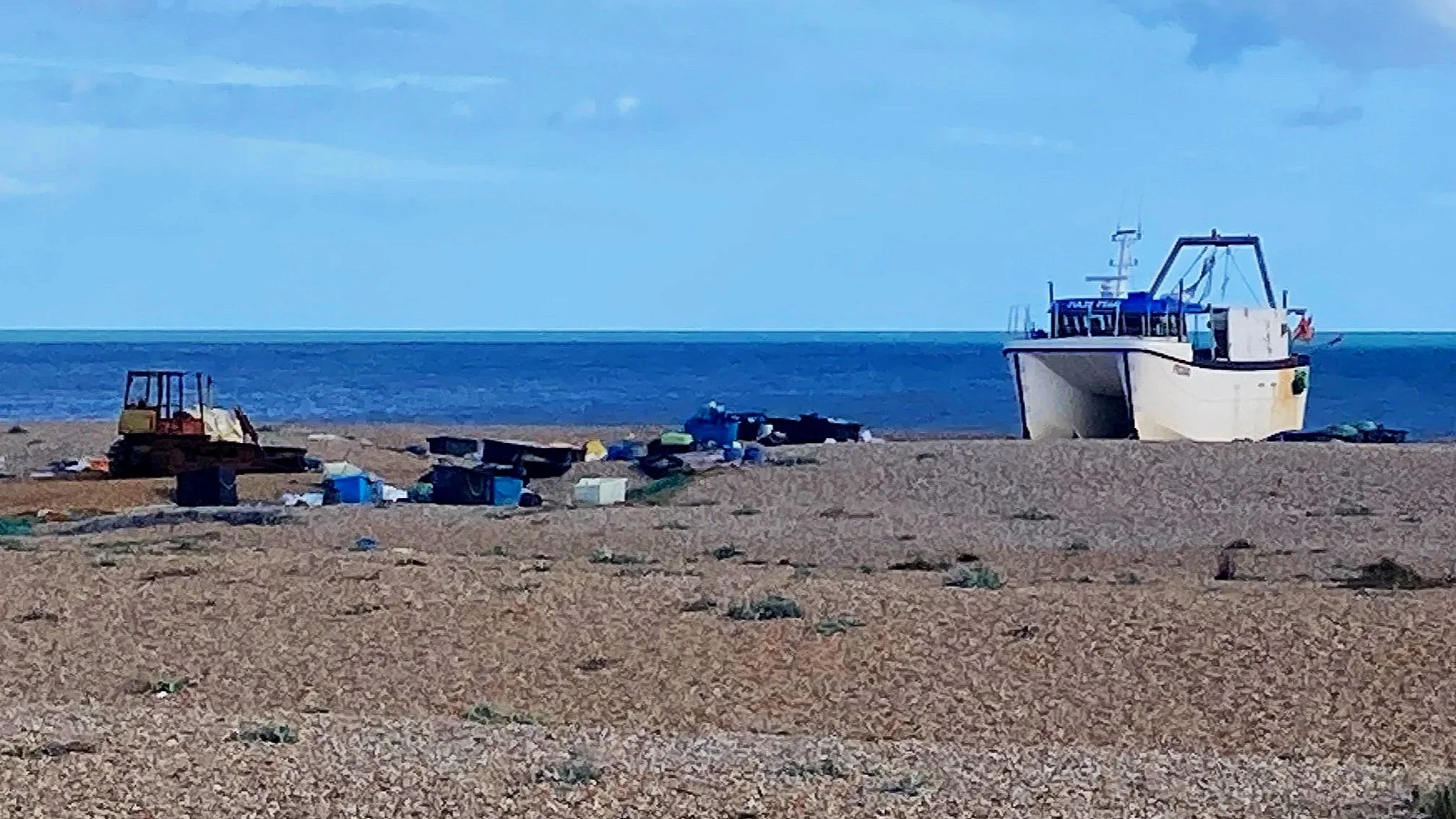
Dungeness, October 2025
‘We stand in awe of gigantic entities massively distributed in time and space’ Timothy Morton, Being Ecological
How do we imagine the future?
Do we look around ourselves now and ponder where change will likely occur?
Do we look to the past to see how the present emerged, spotting trends we might extrapolate into the decades to come?
Do we project today’s hopes and fears on to tomorrow to catch a glimpse of how we’ll live then?
It is difficult enough to predict what your own life will hold a year from now let alone to figure out what the world will look like centuries ahead. There are so many elements and variables to consider. Just thinking about it can be paralysing.
And yet that is exactly what we are being asked to do.
For decades, scientists and environmentalists have been insisting that our reliance on fossil fuels is causing dramatic climate change and untold damage to the world, which will only get worse. We have to change our behaviour as soon as possible or our children will inherit a natural world that is denuded and polluted beyond repair on a climatically dangerous and unstable planet.
This is the story we’ve been told, over and over. It is the story anyone under thirty has grown up with. This is our future if we do not act.
But look around you. Are we acting at pace to change that future? To alter that story?
No, we are repeatedly reminded. Why not?
The philosopher Timothy Morton calls climate change a hyperobject. In Morton’s book, Being Ecological, a hyperobject is described as ‘a thing so vast in both temporal and spatial terms that we can only see slices of it at a time.’ Other hyperobjects include biological evolution, geological time, the pandemic, El Nino and capitalism. They are so huge, occupying and operating over such enormous chunks of space and time that we can only ever catch the tiniest glimpses of them. If you live inside something it is impossible to grasp the whole. We are like the blindfolded trapped in a room with a huge animal, each examining a different part: one grasping a long, hairy tentacle, another a flapping wing of skin, a third a leg the size and shape of a tree trunk. When each describes to the others their part, can any one of them fully imagine the entirety of the elephant in the room?
Science is supposed to be our eyes and ears. To show us that elephant. Morton’s idea of the hyperobject argues why, despite being told all about it, we still can’t see it.
I wrote my novel Exo, a science fiction tale set on a far-future Earth in which humanity is forced to deal with a threat it does not comprehend, because I wanted to understand how we respond to the unknown and uncertain. Do we face it? Do we hide from it? What does it mean to live with uncertainty every day of your life? How might it change and shape us? George Orwell argued that whoever controls the present also dictates what the past means and the future holds. Today’s unknowns and uncertainties cast their shadows over tomorrow.
The inspiration for Exo came from a visit to Dungeness on the southern coast of England in 2004. A small wedge of pebbled plain that juts into the English Channel, Dungeness is inescapably the end of things – a shoreline whose very isolation and bleakness is key to its beauty and allure. To visit is to enter a stark zone of transition, a place where three ever-shifting elements – sea, land, sky – vie for your attention. Come on a foggy or cloudy autumnal or winter day, and a greyish light seems to hang in the air so thickly you might slice it.
Dungeness is a protected nature reserve, yet evidence of people abounds. A single-track road runs through this shingle foreland. Along the road lie a number of tar-painted weatherboard shacks as well as single-storey cottages. It has two lighthouses, Old Lighthouse (Victorian, disused) and New Lighthouse (resembling an Ariane-4 rocket). Just above the point where the pebbles slope sharply down to the sea, numerous fishing boats of various sizes lie like beached whales. The boats seem to be permanently caught in an entropic zone between decay and repair. All are launched from the beach and dragged back out of the water using rusting tractors, bulldozers or winches. The remains of machinery and fishing equipment lie here and there among scattered tufts of grasses and sea kale. At the very end of the single-track road looms a collection of vast concrete boxes. Strung to the boxes are tall, spindly electricity pylons that stride off into the distance, like a paired procession of giants. This is the infrastructure for two nuclear power stations, both now being decommissioned.
What was it about this place which so beguiled me that I’d drive down from London on annual visits? Perhaps it was an island sense of having the turbulent grey sea on more than one side. Or maybe it was seeing the weatherboard cottages, some of which have curious sculptural gardens made from found bits of rusting metal and water-washed wood, like outposts at the end of the world. Here existed stark juxtapositions: beauty and bleakness, wilderness and people, the industrial and the agricultural, technology and tradition. My imagination twitched. The grey sea became a murderous but beguiling entity: an adversary. The fishing boats became abandoned rockets. The old lighthouse a temple. The wooden shacks scavenged homes. The nuclear power station became a research bunker, studying this adversary. And I wasn’t looking at now but into the far future. Dungeness in my imagination took on a wholly alien aspect: a place of danger and dread in which a terrible unknown and fear of that unknown loomed large.
Why had this small stretch of coast triggered this sudden outpouring of weird and fearful imaginings? Two reasons, I think. And both stretch back into my childhood, when I moved to a small island.
In 1976, my parents took us from the Highlands of Scotland to the Channel Island of Jersey, just off the French coast. Jersey is small, just nine by five miles. When you live on a little island you can’t really avoid the sea. Even if you don’t glimpse it every day, it shapes your life. Coming or going means a boat or a plane, but the sea dictated access by air and water. Too windy, and rough seas stopped the boats, leaving supermarket shelves to empty rapidly. Too damp and cold, which was many mornings, and the airport would be lost in fog. Weather and water rule island life.
Living by the sea, you can’t help but contemplate its immensity. Yet for all the vastness stretching to the horizon you are only ever seeing the top of it. Yes, the surface is unstill and, yes, it’s rough and undulating, but what you see is essentially a two dimensional plain. A surface, but no depths. The deeps are the true sea – and contemplating those dark and hidden waters always gives me a shiver. Here be monsters! Jersey also has the third largest tidal range in the world, at twelve metres, and at La Rocque in the southeast of the island, at low tide, miles and miles of rocky reefs are exposed, which vanish at high tide. I look back now at my island life and appreciate that the sea is in key respects another of Morton’s hyperobjects.
If my first reason to be thinking weird thoughts was an island, a place, the second reason was a time.
To grow up in the seventies and eighties was to live with a persistent, nagging anxiety – to live under a shadow. Like most, if not all, children of the Cold War, the threat of nuclear strikes loomed large in my imagination. Two world wars had been fought, and my grandparents had lived through both. The monolithic political and ideological blocks of the East and West viewed each other with fear and suspicion over walls and fences as they built evermore destructive bombs. Cars bore window stickers reminding me that as a resident of Jersey the French nuclear power station at Le Havre would be a target for the USSR’s missiles.
The shadows of death foretold, I learned, stretched across the whole world. Though the term didn’t exist back then, here was another hyperobject that I was trapped inside.
Space and time. A small island in the capricious sea and the threat of nuclear war. A visit to sea-shaken, nuclear-power-generating Dungeness and all the unknowns of childhood were re-emerging in a wild flight of the imagination.
Exo is set a millennium from now, when the Earth has long been abandoned. What happened? Over hundreds of years the water in our oceans transformed into a deadly multidimensional liquid entity – dubbed the Caul – that irresistibly attracts any living thing that gets too close, and which vanishes on contact. Earth’s refugees survive in habitats across the solar system, while scientists risk their lives in research bunkers probing the Caul, seeking answers. There are also penitents – people who’ve illegally come to Earth: some to worship this entity, others to enter it. A few, unexpectedly, endure along the shore. One such is Mae Jameson, an 81-year-old former policewoman who followed her husband here thirty years ago. Our story begins with Mae finding a mute child, alone on the shore. When she returns the child to her father, rogue scientist Carl Magellan, she finds him dead in suspicious circumstances. Suddenly responsible for this child, octogenarian Mae sets about investigating the death and, with the help of Magellan’s journals detailing his discoveries of the Caul’s secrets, uncovers a conspiracy which will shape the future of human life.
In my story the Caul is a beguiling and terrifying hyperobject. Something that resists efforts to understand it, and the closer you get to it the more stupefying it becomes. Along the Caul’s shores, strange multidimensional topological structures appear that my scientist Magellan dares to visit. These never appear the same twice, shifting between tides. Exploring such mathematical structures has consequences Magellan cannot fully comprehend. He and his fellow scientists glimpse parts of a great mystery but never the whole. Both haunted by and drawn to the Caul, their need is to understand it. What they do not grasp is that by living in the shadow of this vast unknown entity they are being shaped by it. Human responses – fear, hate, curiosity, submission – alter them. But there are those who see the Caul as an opportunity. They can exploit humankind’s response to the Caul for their own gain, whether that be wealth or power or bringing about their own vision of what the future should be.
In Jeff VanderMeer’s award-winning Southern Reach tetralogy, he has described his weird Area X, into which no human going in comes out unchanged, as a haunting. In E. J. Swift’s Arthur Clarke-Award nominated The Coral Bones, Swift uses three timelines – past, present, future – to map the shape of the climate emergency we find ourselves in. These and other recent works, often described as CliFi – Climate Fiction – attempt to grapple with the shadow that looms over us. Just as my generation felt anxious growing up in the Cold War, those under thirty have lived their whole lives being told stories of the climate crisis. Is it any wonder they are fearful of what the future holds?
Knowing about hyperobjects will not help us to grasp them completely. We must still live with their uncertainty. They will still haunt us. But recognising and accepting such ghostly presences may allow us to better live with them. Our fears need not control us, and we can be more clear-eyed about anyone trying to shape our responses to what is to come.
And that means looking more clearly and imaginatively into our future.